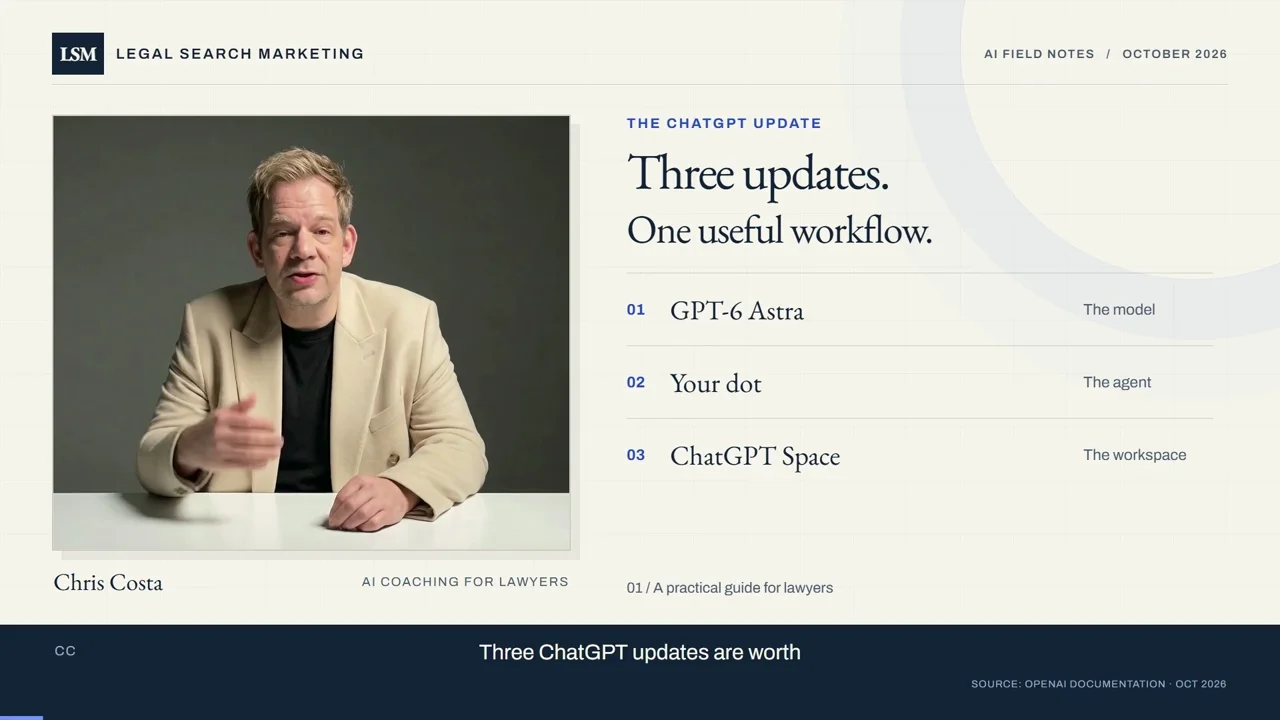
AI for Lawyers This Week: Voice Updates, API Retirement Dates, and AI Evidence
Three developments for law firms: new ChatGPT voices, January API retirement dates, and an evidence-rule agenda addressing deepfakes and AI-generated evidence.


This week's useful AI news is as much about maintaining existing tools as trying new ones. A voice update gives teams something to test. An API retirement notice gives software owners a deadline. A federal committee agenda highlights continuing questions about authenticating digital evidence.
Here are three developments tied to October 10–16. Provider announcements and committee materials establish the facts below. Suggested law firm applications are our interpretation, not evidence of improved results or a statement of new legal requirements.
1. ChatGPT Voice begins another rollout
What changed: OpenAI's October 15 release notes announce GPT-Live-1.1 and the smaller GPT-Live-1.1 Quip in ChatGPT Voice. The update includes additional voices and changes to spoken indications that the system is searching. Available voices vary by account and region. OpenAI release notes, October 15
Practical implication: A firm could try a generic training exercise, such as rehearsing how staff explain the consultation process. Treat this as a test of an internal practice tool. This announcement does not establish availability in a third-party phone assistant, nor does it show that a model can handle client intake accurately.
What to verify: Confirm which voices appear in the actual account. Test names, interruptions and corrections using invented practice scenarios. Check the firm's account controls before introducing client information. A more natural voice does not establish factual accuracy.
2. Certain GPT-4 API models receive a January retirement date
What changed: OpenAI's October 14 notice sets January 14, 2027 as the API shutdown date for specified GPT-4o snapshots, GPT-4o mini, GPT-4.1 and GPT-4.1 mini. Fine-tuned versions follow the underlying model's schedule. The notice recommends gpt-6-luna as the replacement. This concerns listed API models; it is not an announcement that every ChatGPT feature stops working. OpenAI deprecation notice and exact model IDs
Practical implication: If your firm uses a custom document tool, intake classifier or dashboard assistant, ask its developer whether it calls an affected model. A tool that still works today may need a planned migration.
What to verify: Request the exact configured model ID, a responsible owner and a test plan. Compare output, response time and total operating cost before switching. The notice does not establish replacement pricing for your particular workflow. Check current rates and your vendor's contract separately. Keep a rollback or alternative workflow available during testing.
Our Build, Buy, or Fix guide provides a worksheet for evaluating an existing tool before commissioning changes.
3. AI evidence and deepfakes appear on the federal committee's October agenda
What changed: The official Advisory Committee on Evidence Rules agenda for its October 15 meeting in Boston includes panel discussions on deepfakes, authenticity and AI-generated evidence. The materials address proposed Rules 901(c) and 707. The agenda was published before this coverage week; the scheduled meeting date falls within it. These materials establish planned discussion, not what participants ultimately decided or that a proposal took effect. U.S. Courts agenda book, agenda at PDF page 5
Practical implication: Litigation teams have a reason to review how they preserve original media and document its source. That is an operational suggestion, not a new evidence standard announced by this article.
What to verify: Consult the rules currently in force and applicable orders for the actual matter. Check later official minutes or published proposals before describing committee action. Do not rely on an automated deepfake label alone to establish authenticity or fabrication.
One useful action this week
Make a short inventory of the AI tools your firm already uses. Record the owner, account, configured model where known, intended task and next review date. That makes it easier to investigate a product change without interrupting everyday work.
If you want help choosing priorities, our $499 AI Assessment includes two Zoom calls and a written report. The $299/month AI Concierge provides a monthly report and Zoom call to help the firm keep track of relevant updates; additional work is scoped as needed. Neither service promises a particular saving or outcome.

Christopher Costa
Founder of Legal Search Marketing, helping law firms transform their practice with AI. Expert in GEO optimization, AI implementation, and legal technology strategy.
Ready to Implement AI at Your Firm?
Schedule a discovery call to discuss how AI can transform your practice.
Schedule Discovery Call